
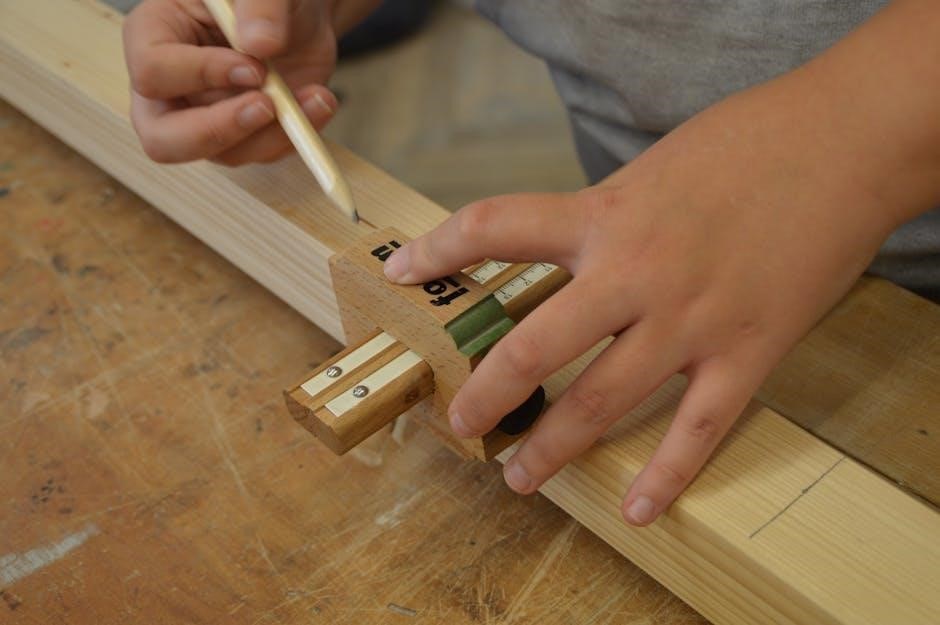
The Cam-A-Line Dowel Guide revolutionizes woodworking, offering effortless precision for strong dowel joints and customizable spacing for optimal results.
Woodpeckers’ system combines a robust fence, versatile stop, and engraved centerlines – the most complete dowelling jig available today.
Jay Mowder’s video demonstrates building an end table, showcasing an organized layout process to keep your projects perfectly on track.
What is the Cam-A-Line Dowel Guide?
The Cam-A-Line Dowel Guide, manufactured by Woodpeckers, is a precision dowelling jig designed to simplify and enhance the accuracy of creating dowel joints in woodworking projects.
This innovative system allows woodworkers to effortlessly execute precise and strong dowel joints, customizing dowel spacing to meet specific project requirements. It’s a comprehensive solution, integrating variable spacing, precision-engraved centerlines, a robust fence, and a versatile stop system.
Essentially, it’s a tool built for consistently accurate dowel placement, streamlining the process and improving the overall quality of woodworking builds.
Key Features and Benefits
Key features of the Cam-A-Line include variable dowel spacing, allowing customization for diverse projects, and precision-engraved centerlines ensuring accurate drilling. The robust fence provides stability, while the versatile stop system guarantees consistent hole placement.
Benefits include effortless creation of strong dowel joints, improved project accuracy, and a streamlined workflow. Users experience enhanced precision, reduced errors, and time savings. Jay Mowder’s demonstration highlights its organizational advantages, keeping projects on track.
Ultimately, it delivers professional-quality results with ease.

Understanding the Components
The Cam-A-Line consists of a drill guide, index pin, stop block, and fence system, all working in harmony to deliver precise dowel placement and consistent results.
The Drill Guide
The Drill Guide is the central component, featuring outer drill guides for the initial dowel hole using the Index Pin, and subsequent holes utilizing the Stop Block indexing system.
This guide ensures accurate and consistent drilling, crucial for creating strong and aligned dowel joints. It’s designed to accommodate various drill bit sizes, offering versatility for different woodworking projects.
Precision-engraved centerlines within the guide further enhance accuracy, allowing for pinpoint placement of each dowel hole. The robust construction guarantees stability during operation.
The Index Pin
The Index Pin plays a vital role in establishing the initial dowel hole’s position within the Cam-A-Line system. It’s used in conjunction with the outer Drill Guide to ensure the first dowel is perfectly placed.
This pin provides a reliable reference point, guaranteeing consistent starting alignment for all subsequent dowel holes. Its precise design contributes to the overall accuracy of the dowelling process.
After the initial hole is drilled with the Index Pin, the Stop Block takes over for repeatable, accurate dowel placement throughout the project.
The Stop Block
The Stop Block is central to the Cam-A-Line’s efficiency, enabling consistent and repeatable dowel hole spacing after the initial setup. Following the first dowel drilled using the Index Pin, the Stop Block indexes for subsequent holes.
This feature dramatically speeds up the dowelling process while maintaining exceptional accuracy. It allows for quick creation of evenly spaced dowel patterns across your workpiece.
The Stop Block’s design ensures each dowel is positioned precisely, contributing to strong and aligned joints in your woodworking projects.
The Fence System
The Fence System of the Cam-A-Line Dowel Guide provides a stable and reliable reference point for accurate dowel placement. This robust fence ensures consistent alignment throughout the drilling process, crucial for strong, square joints.
Combined with the guide’s other components, the fence contributes to the overall precision that Woodpeckers is known for.
It works in harmony with the drill guide, index pin, and stop block to deliver repeatable results, making the Cam-A-Line a versatile tool for various woodworking applications.
Setting Up the Cam-A-Line Dowel Guide
Proper setup involves attaching the guide rod and adjusting dowel spacing to your project’s needs, then securely fastening the workpiece for accurate drilling.
Attaching the Guide Rod
To begin, install the Guide Rod to both sides of the Cam-A-Line system, ensuring a secure fit for optimal performance. This rod acts as the central alignment point throughout the dowelling process.
The guide rod’s precise positioning is crucial for maintaining consistent dowel hole placement across your woodworking projects. It provides a stable foundation for the indexing pin and stop block.
Double-check the rod’s attachment before proceeding, as any looseness can compromise the accuracy of your dowel joints. A firmly secured guide rod is essential for reliable results.
Adjusting Dowel Spacing
The Cam-A-Line excels with its customizable dowel spacing, adapting to diverse project needs. Easily modify the distance between dowels to achieve optimal joint strength and aesthetic appeal.
This flexibility is achieved through the system’s adjustable stop block and precisely engraved centerlines, allowing for accurate and repeatable spacing configurations; Fine-tune the settings to match your specific wood thickness and joint requirements.
Experiment with different spacings to discover the ideal setup for your woodworking creations, ensuring a professional and robust final product.
Securing the Workpiece
Properly securing your workpiece is crucial for accurate dowel drilling with the Cam-A-Line. A stable setup prevents shifting during operation, ensuring consistent and aligned holes.
Utilize clamps to firmly attach the wood to your workbench, ensuring it remains flush against the Cam-A-Line’s fence system. This minimizes movement and maximizes precision throughout the drilling process.
A well-secured workpiece is paramount for achieving strong, reliable dowel joints and a professional finish in your woodworking projects.

Using the Cam-A-Line Dowel Guide for Drilling
Begin by drilling the initial dowel hole using the Index Pin, then leverage the Stop Block for consistent, subsequent holes with remarkable accuracy.
Centerlines ensure precise alignment, resulting in strong and perfectly fitted dowel joints for your woodworking endeavors.
Drilling the First Dowel Hole
To initiate the dowelling process with the Cam-A-Line, carefully install the Guide Rod. Then, position your workpiece securely against the fence system, ensuring it’s firmly held in place for accurate drilling.
Utilize the outer Drill Guide and the Index Pin to precisely drill your very first dowel hole. This initial hole establishes the foundational point for all subsequent dowel placements.
Take your time and maintain a steady hand during this step, as the accuracy of this first hole is crucial for the overall alignment of your project.
Utilizing the Stop Block for Subsequent Holes
After successfully drilling the initial dowel hole using the Index Pin, transition to the Stop Block for consistent and accurate placement of the remaining dowels.
The Stop Block indexes against the previously drilled hole, guaranteeing uniform spacing between each dowel. This feature significantly streamlines the process and minimizes errors.
Simply align the Stop Block with the first hole and proceed to drill subsequent holes, relying on the jig’s precision to maintain consistent dowel alignment throughout your project.
Ensuring Accuracy with Centerlines
The Cam-A-Line Dowel Guide incorporates precision-engraved centerlines directly onto the drill guide, providing a clear visual reference for accurate dowel placement.
These centerlines align perfectly with the drill bit, eliminating guesswork and ensuring that each dowel hole is drilled precisely on the intended centerline of your workpiece.
This feature is crucial for achieving tight-fitting, strong dowel joints, and contributes significantly to the overall accuracy and quality of your woodworking projects.

Advanced Techniques
The Cam-A-Line Dowel Guide excels at angled dowel holes and creating dowel arrays, adapting to various wood thicknesses for versatile woodworking applications.
Master these techniques to unlock the full potential of precise, repeatable joinery with this innovative system.
Drilling Angled Dowel Holes
The Cam-A-Line Dowel Guide doesn’t limit you to straight dowel joints; it facilitates drilling angled holes with remarkable accuracy. This opens up design possibilities for furniture requiring unique structural connections.
To achieve angled drilling, utilize a wedge or angled support under the workpiece, carefully adjusting the angle to your desired specification. The guide’s robust fence system maintains stability during this process, ensuring consistent results.
Remember to account for the angle when planning your project, as it will affect the overall dimensions and alignment of the assembled pieces. Practice on scrap wood first to refine your technique.
Creating Dowel Arrays
The Cam-A-Line Dowel Guide excels at producing precise dowel arrays, ideal for applications needing multiple, evenly spaced connections. This feature significantly speeds up assembly processes for larger projects like shelving or panel construction.
Leverage the stop block’s indexing capabilities to consistently space dowel holes across the workpiece. Adjust the stop block incrementally for each pass, ensuring uniform distances between each dowel location.
Careful planning and accurate measurements are crucial for successful dowel arrays. Double-check your spacing before drilling to avoid errors and maintain project integrity.
Working with Different Wood Thicknesses
The Cam-A-Line Dowel Guide demonstrates versatility when joining wood of varying thicknesses. Its adjustable fence system accommodates diverse material dimensions, ensuring consistent dowel alignment regardless of stock size.
Proper setup is key; securely attach the guide to the workpiece and adjust the fence to match the wood’s thickness. This prevents misalignment and guarantees strong, flush joints.
Consider dowel length relative to wood thickness – sufficient length is vital for a secure hold. The Cam-A-Line’s precision aids in achieving professional results across all projects.

Cam-A-Line vs. Other Dowel Jigs
The Cam-A-Line distinguishes itself from competitors like DowelMax through variable spacing, precision-engraved centerlines, and a robust fence system, offering superior woodworking control.
Woodpeckers’ design prioritizes accuracy and versatility, exceeding standard dowel jig capabilities.
Cam-A-Line vs. DowelMax
Comparing the Cam-A-Line to the DowelMax reveals key differences in design philosophy and functionality. While both aim for accurate dowel joinery, the Cam-A-Line boasts variable spacing, allowing for greater customization in project design and material thickness.
DowelMax, while effective, often relies on pre-set spacing options. The Cam-A-Line’s precision-engraved centerlines further enhance accuracy, simplifying alignment and reducing errors during drilling. Woodpeckers emphasizes a complete system, integrating a robust fence and versatile stop, providing a more comprehensive solution for diverse woodworking needs compared to the DowelMax.
Advantages of Cam-A-Line Precision
The Cam-A-Line’s precision stems from its meticulous machining and inspection, performed in Woodpeckers’ Ohio facility. This dedication to quality translates directly into highly accurate dowel joints, minimizing gaps and maximizing structural integrity in woodworking projects.
The system’s variable spacing and engraved centerlines eliminate guesswork, ensuring consistent alignment. This precision reduces material waste and rework, saving time and resources. Ultimately, the Cam-A-Line empowers woodworkers to achieve professional-quality results with confidence and efficiency.
Cost Comparison
Comparing the Cam-A-Line to alternatives like the DowelMax reveals a price difference reflecting feature sets and build quality. While DowelMax offers a functional solution, the Cam-A-Line generally represents a higher investment.
However, the Cam-A-Line’s comprehensive system – including variable spacing, precision centerlines, and robust fence – justifies the cost for serious woodworkers. Considering long-term durability, accuracy, and reduced material waste, the Cam-A-Line provides substantial value despite its initial price point.

Applications in Woodworking Projects
The Cam-A-Line Dowel Guide excels in diverse projects, from building sturdy end tables and robust shelves to precisely assembling drawers with ease.
Its accuracy ensures strong, aligned joints, elevating the quality and durability of your woodworking creations.
Building End Tables
The Cam-A-Line Dowel Guide significantly simplifies end table construction, ensuring consistently accurate and robust joints. Jay Mowder’s instructional video specifically demonstrates this application, highlighting a streamlined workflow.
Begin by carefully laying out your table components, then utilize the guide’s precision to drill perfectly aligned dowel holes in both connecting pieces.
The adjustable stop block facilitates consistent spacing, crucial for a professional finish. This jig minimizes errors, resulting in a square, stable, and aesthetically pleasing end table, even for beginners.
Constructing Shelves
The Cam-A-Line Dowel Guide excels in shelf construction, guaranteeing strong, aligned joints for lasting stability. Its variable spacing allows customization for different shelf thicknesses and designs, offering versatility in your projects.
Employ the guide to drill precise dowel holes in shelf supports and the shelves themselves, ensuring a flush and secure fit.
The engraved centerlines and robust fence contribute to accuracy, while the stop block maintains consistent spacing across multiple shelves, resulting in a professional-quality shelving unit.
Assembling Drawers
The Cam-A-Line Dowel Guide significantly simplifies drawer assembly, creating robust and square corners. Precise dowel placement, facilitated by the guide, ensures drawers slide smoothly and withstand repeated use.
Utilize the adjustable stop block to maintain consistent dowel spacing for drawer fronts, sides, and backs, streamlining the building process;
The system’s accuracy minimizes racking and wobble, resulting in drawers that fit perfectly within the drawer box, enhancing both functionality and the overall quality of your woodworking.
Maintenance and Care
Regular cleaning and inspection of Cam-A-Line components are crucial for sustained precision. Proper storage protects against damage, ensuring long-lasting performance and accuracy.
Cleaning the Guide
Maintaining a clean Cam-A-Line Dowel Guide is essential for accurate dowel placement; After each use, remove sawdust and wood debris with a soft brush or compressed air. Avoid using harsh solvents or abrasive cleaners, as these can damage the precision-machined surfaces.
Pay particular attention to the drill guides and index pin, ensuring they are free from obstructions. A clean guide ensures smooth operation and prevents inaccuracies in your woodworking projects, prolonging the life of your valuable tool.
Inspecting Components
Regularly inspect your Cam-A-Line Dowel Guide for any signs of wear or damage. Check the drill guide bushings for cracks or looseness, and ensure the index pin moves freely. Examine the stop block for accurate indexing and the fence system for secure clamping.
Woodpeckers emphasizes precision machining; therefore, any deviations could affect accuracy. Promptly address any issues to maintain optimal performance and prevent potential errors in your woodworking endeavors, ensuring lasting precision.
Proper Storage
To ensure longevity, store your Cam-A-Line Dowel Guide in a clean, dry environment, protected from dust and extreme temperatures. A dedicated case or compartment is ideal. Avoid leaving the jig exposed to moisture, which can cause corrosion or warping of components.
Proper storage prevents damage and maintains the precision Woodpeckers is known for. Careful handling and storage will guarantee years of accurate dowel joint creation in your woodworking projects.
Troubleshooting Common Issues
Common problems include dowel misalignment, drill bit slippage, and stop block inaccuracy. Ensure proper setup, secure clamping, and sharp drill bits for optimal results.
Dowel Holes Not Aligning
If dowel holes aren’t aligning, double-check the Cam-A-Line’s setup and workpiece security. Verify the guide rod is firmly attached and the fence is square to the workpiece’s edge.
Ensure consistent clamping pressure throughout the drilling process; movement during drilling causes misalignment.
Inspect the index pin and stop block for any damage or looseness, as these directly impact hole placement. A slightly off-kilter component can create significant errors.
Finally, confirm you’re using the correct drill bit size and applying even pressure while drilling.
Drill Bit Slippage
Drill bit slippage within the Cam-A-Line’s guide can compromise accuracy and create uneven dowel joints. Ensure you’re using a sharp drill bit specifically designed for wood, and that it’s securely chucked in your drill.
Reduce drilling speed; excessive speed generates heat and can cause the bit to wander. Applying consistent, moderate pressure is crucial, avoiding forceful pushing.
Inspect the drill guide itself for wear or damage – a worn guide won’t hold the bit steady. Consider using a drill bit lubricant to reduce friction and improve control.
Stop Block Inaccuracy
Stop Block inaccuracy can lead to inconsistent dowel hole spacing, defeating the Cam-A-Line’s precision. Verify the stop block is firmly secured to the guide rod and hasn’t shifted during use.
Double-check your initial dowel spacing measurement and ensure the stop block is accurately positioned. Slight vibrations during drilling can cause minor shifts, so re-verify after each few holes.
Inspect the stop block’s contact surface for debris or wear, which could affect its consistent stopping point. A clean, smooth surface is essential for reliable results.
Resources and Further Learning
Explore Woodpeckers’ website for detailed information and support. Jay Mowder’s videos offer practical demonstrations, while online forums provide community insights.
Woodpeckers Website
The site offers downloadable resources like detailed manuals and helpful guides to maximize your experience. Customers can also find frequently asked questions and access Woodpeckers’ dedicated customer support team for assistance. Explore additional Woodpeckers’ innovative woodworking tools and accessories, enhancing your workshop capabilities.
Instructional Videos (Jay Mowder Example)
Jay Mowder’s 12-minute video provides a practical demonstration of the Cam-A-Line Dowel Guide in action, specifically building a simple end table. He meticulously walks viewers through a highly organized layout process, emphasizing how the jig maintains project accuracy.
These visual tutorials are invaluable for understanding setup, operation, and advanced techniques. Search platforms like YouTube for “Cam-A-Line Dowel Guide” to find additional demonstrations and user experiences, accelerating your learning curve and maximizing the tool’s potential.
Online Forums and Communities
Engaging with online woodworking communities offers a wealth of knowledge regarding the Cam-A-Line Dowel Guide. Forums and dedicated groups provide platforms to ask questions, share project experiences, and troubleshoot challenges with fellow users.
These spaces often feature detailed discussions on techniques, modifications, and comparisons with alternative dowelling systems. Active participation can unlock valuable insights, accelerate your learning, and connect you with a supportive network of woodworking enthusiasts.

The Role of CAM Technology in Woodworking
CAM (Computer-Aided Manufacturing) enhances woodworking precision; integrating with systems like the Cam-A-Line Dowel Guide for efficient, repeatable, and accurate results.
CAM (Computer-Aided Manufacturing) Overview
CAM, or Computer-Aided Manufacturing, represents a pivotal shift in modern production, utilizing computer systems to control and automate manufacturing processes. It bridges the gap between design and physical creation, translating digital models into instructions for machines.
While the Cam-A-Line Dowel Guide isn’t directly computer-controlled, the principles of CAM – precision, repeatability, and efficiency – are embodied in its design. The guide’s accurate machining and consistent results reflect the core tenets of CAM technology, allowing woodworkers to achieve professional-grade joinery with greater ease.
Essentially, CAM aims to optimize manufacturing, and the Cam-A-Line achieves optimization within the specific task of dowel joinery.
Integration with Dowel Guide Systems
Though the Cam-A-Line Dowel Guide itself isn’t a digitally integrated CAM system, the principles of CAM – precision and repeatability – enhance its functionality. Modern woodworking increasingly sees integration of CAM-driven CNC machines alongside traditional tools like dowel jigs.
This synergy allows for complex component creation via CNC, followed by precise assembly using guides like the Cam-A-Line; The guide ensures accurate dowel placement, crucial for strong, aligned joints in projects combining both methods.
Ultimately, the Cam-A-Line complements CAM workflows, offering a reliable, manual solution for a critical step.

DroidCam OBS Plugin and its Relevance
The DroidCam OBS plugin isn’t directly related to the Cam-A-Line, but enables high-quality audio and video input into OBS, useful for recording woodworking tutorials.
Connecting Phone Cameras to OBS
While seemingly unrelated to the Cam-A-Line Dowel Guide, the DroidCam OBS plugin offers a valuable solution for woodworkers wanting to create instructional content. This plugin facilitates connecting your smartphone camera directly to OBS (Open Broadcaster Software), transforming your phone into a high-quality webcam.
This allows for clear visual demonstrations of techniques like using the Cam-A-Line, showcasing precise dowel alignment and the jig’s features. The plugin provides a DirectShow Output, functioning as a virtual camera source within OBS, delivering superior audio and video quality compared to standard webcams.
High-Quality Audio and Video Input
Though distinct from the Cam-A-Line Dowel Guide itself, utilizing the DroidCam OBS plugin significantly elevates the quality of woodworking tutorials. It provides a substantial upgrade over typical webcam audio and video, crucial for clearly demonstrating the jig’s precision.
This enhanced clarity allows viewers to easily observe the Cam-A-Line’s features, such as the index pin and stop block, during operation. High-quality visuals are essential for accurately conveying techniques and ensuring viewers can replicate successful dowel joint creation.
Woodpeckers Manufacturing Process
Like all Woodpeckers products, the Cam-A-Line Dowel Guide is meticulously machined and carefully inspected in their Strongsville, Ohio facility.
This dedication ensures exceptional precision and quality, embodying Woodpeckers’ commitment to superior woodworking tools.
Made in Ohio
Woodpeckers proudly manufactures the Cam-A-Line Dowel Guide entirely within their state-of-the-art facility located in Strongsville, Ohio, just south of Cleveland.
This commitment to domestic production allows for stringent quality control throughout every stage of the manufacturing process, ensuring consistently high standards.
By keeping production local, Woodpeckers supports American jobs and maintains a direct connection to the craftsmanship and innovation that define their brand. This dedication translates into a superior product for woodworking enthusiasts.
Precision Machining and Inspection
The Cam-A-Line Dowel Guide benefits from Woodpeckers’ dedication to precision machining, utilizing advanced techniques to achieve exceptional accuracy in every component.
Each part undergoes rigorous inspection, ensuring it meets the company’s exacting standards for quality and performance. This meticulous process guarantees consistent, repeatable results for woodworking projects.
Woodpeckers’ commitment to detail ensures that the Cam-A-Line delivers the reliability and precision that professional woodworkers and hobbyists demand, time and time again.